

SIGNAL VOICESSIGNAL 007
Anastasiya Ty A World That Can Still Change
Identity in motion, strength without hiding vulnerability, Lisbon’s underground, the dancefloor as a shared state, and protecting curiosity as the audience grows.

Signal 007
Anastasiya Ty describes artistic identity less as something inherited from one place than something assembled across movement, Lisbon, failure, performance and change. That same refusal of fixed categories runs through how she talks about strength and vulnerability, sound and image, the underground and a rapidly expanding audience.
Across ten questions, the conversation moves from personal formation to the dancefloor and back again. The constant is not hardness for its own sake, but the attempt to build a world that can remain intense without becoming emotionally closed or predictable.
- Based in
- Lisbon
01
Identity is built in motion.
You have lived between different cultures and eventually built your artistic identity within Portugal’s electronic scene. When you think about Anastasiya Ty today, which parts of that identity come from where you started, and which parts were shaped by the person you became along the way?
I think Anastasiya Ty is a combination of everything I’ve experienced, but not necessarily a direct reflection of any one place I’ve lived. Where I started gave me certain values, instincts and ways of seeing the world, while everything that happened afterwards, the people I met, the places I lived, the challenges I went through and the different scenes I experienced, slowly shaped how I express those things in life and music as well.
Portugal, Lisbon in particular, became very important to that process because it was here that I really began building Anastasiya Ty as an artist within an electronic music environment. But I don't think Portugal simply “gave me” my artistic identity. It gave me the space to experiment, to meet people, to perform, to fail, to evolve and eventually understand what actually felt like mine. So I’d say where I started gave me the foundations, but the person I became along the way gave Anastasiya Ty her identity. And I think that identity is still evolving.
02
Strength and vulnerability can coexist.
There is an interesting contrast in your work: the music can feel intense, physical and uncompromising, while the world around it can also feel very personal and emotionally charged. Do you consciously explore that tension between strength and vulnerability?
Definitely. I think that contrast is actually one of the most important parts of Anastasiya Ty, even if I didn't consciously understand it that way when I started.
For a long time, intensity was a way of expressing myself. The harder, louder and more aggressive the music was, the easier it was to communicate something that I couldn't necessarily put into words. There was a kind of protection in that strength. But I've realised that strength and vulnerability aren't opposites. In fact, the more comfortable I've become with myself, the less I feel the need to hide vulnerability behind aggression. I can make something physically intense and still let it be emotional, intimate or even fragile underneath.
I love the physicality of hard kicks and heavy rhythms, but I also want melodies, vocals and emotion to exist inside that world. I want the music to make you move, but I also want something in it to stay with you afterwards.
So yes, I explore that tension consciously now where i don’t need to choose between being powerful and being vulnerable, because i can be both!
i don’t need to choose between being powerful and being vulnerable, because i can be both!
03
The visual world is another language.
Your visual identity feels like an extension of the music rather than something added afterwards. When you are developing a new release or concept, do you already see the visual world in your head while making the music, or does that side of the project emerge later?
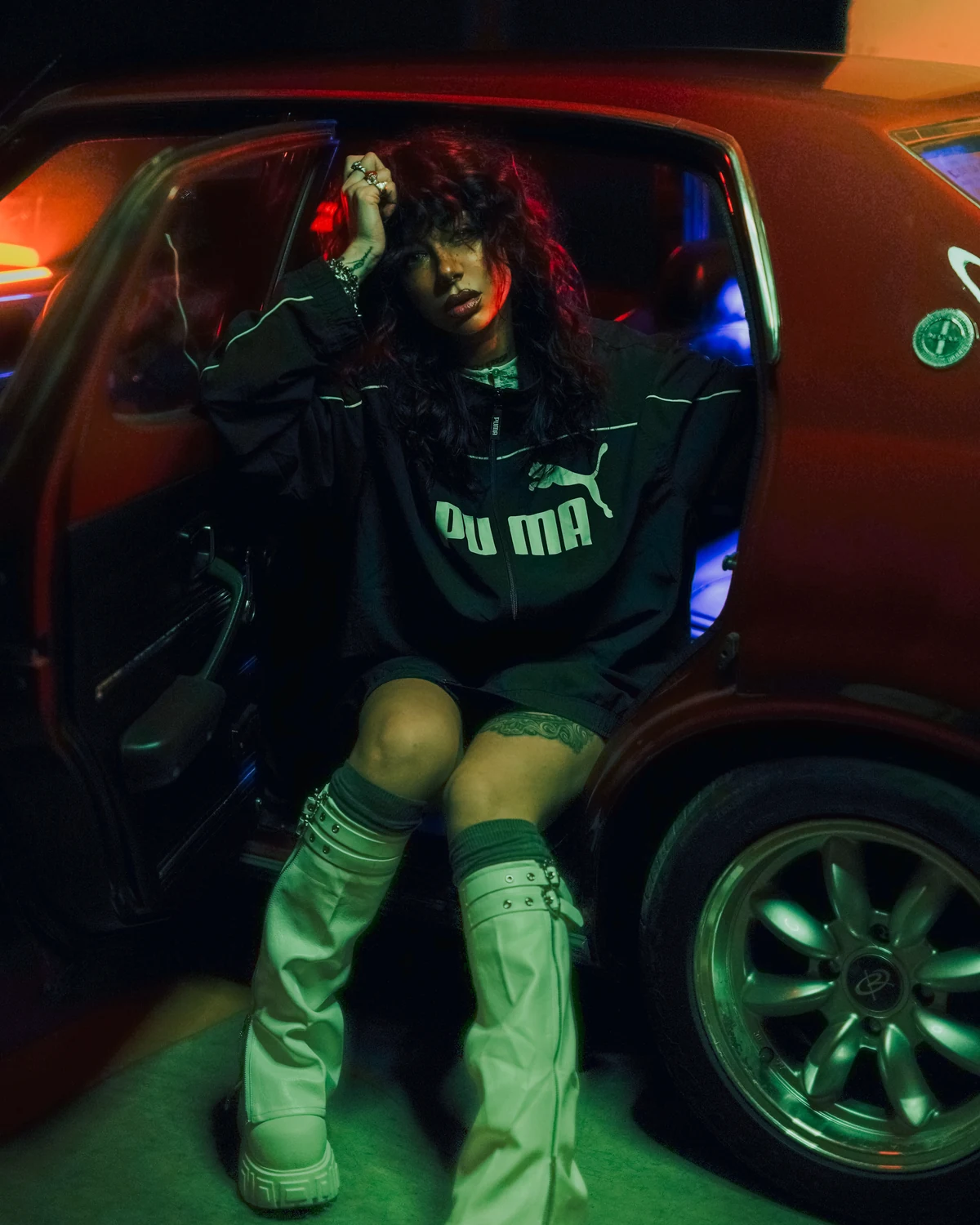
For me, they usually develop together. I don't necessarily sit down and make a track thinking, “this is what the artwork needs to look like”, but I tend to visualise music very strongly. I see colours, textures, environments, movement, sometimes even specific scenes or characters while I'm working on something.
The visual side can start with the music, but sometimes it's the opposite. I'll have an image, a texture, a feeling or even just a very specific atmosphere in my head, and that can become the starting point for the sound. They constantly feed each other.
I've always been very involved in the visual side of Anastasiya Ty because I don't see it as decoration. It's another language. It’s who i am. The music can communicate something emotionally, while the visual world can communicate something that isn't necessarily said directly.
Ideally, when the music and visuals work together, they create a world that feels bigger than either one on its own.
And to be honest my visual part is in the process of change at the moment, so we’ll see where it takes me. I want there to be symbols and details that aren't immediately explained, so that the audience can bring their own interpretation into it. Just like art, and just like how i imagine people to perceive me, they all have their own idea or opinion, and that is beautiful.
It's another language. It’s who i am.
04
Growth without losing the rawness.
Hard techno has reached an enormous new audience over the last few years. From your perspective inside the scene, what excites you most about that growth, and what do you hope techno never loses as it continues to evolve?
What excites me most is that hard techno is reaching people who might never have discovered it otherwise. I’ve been told this before, they share their experiences with me and how they never imagined to enjoy it so much.
Honestly there is something very powerful about seeing a sound that was once quite niche become something that people from completely different backgrounds can connect with.
And the most exciting part of that growth isn't necessarily the numbers or how big the events become. It's seeing how many different interpretations of the sound can now exist. People are bringing in influences from other genres, cultures and scenes, and I think that can push the music into places we haven't heard before.
At the same time, I hope techno never loses its rawness. For me, it has always been about a physical and almost primal connection to sound, the kick, the repetition, the tension, the release, and the feeling of losing yourself in it. It doesn't have to be polished or complicated to be powerful. And i also hope it doesn't lose its freedom. Techno has always had space for people to experiment and create their own version of it. Genres naturally evolve, and I don't think we should try to freeze them in time. I'd rather see techno keep changing while holding onto that feeling of freedom, intensity and connection that made people fall in love with it in the first place.
05
A release can become a world.
Projects and titles such as 333, Sextape and some of your recent work suggest that you are interested in creating a complete atmosphere around a release, not simply producing isolated club tracks. How important is storytelling to you, even in music that is primarily designed for the dancefloor?
Storytelling is very important to me, although I don't always think of it as telling a story in a traditional beginning-middle-end way. I think more in terms of creating a world, a feeling or a journey that someone can enter.
With 333, for example, the project was very intentional as a whole. The number itself has personal meaning to me, and the album was structured around different parts of the heart, the journey i have lived through. Each track has its own emotional identity, but they are connected, so listening to the whole thing feels different from simply putting together a collection of club tracks.
Even when I'm making something that is primarily meant for the dancefloor, I don't want the emotion to disappear. A kick can be physical, but the reason you're reacting to it can be emotional. A melody or a vocal can trigger a memory while your body is still moving. I find that combination really interesting and something i pay close attention to.
Titles like 333 or Sextape also come from that way of thinking. A title doesn't necessarily explain the entire piece, sometimes it gives you a doorway into it. I like leaving some things open enough for people to create their own interpretation.
Ultimately, I want my releases to feel like experiences rather than just tracks. If someone hears one of my songs in a rave and has an incredible night, that's already meaningful to me. But if they later listen to it alone and it suddenly reminds them of something personal in their own life, that's when I feel the music has really travelled somewhere beyond me.
06
Freedom and friction in the same city.
Portugal, and Lisbon in particular, has developed a very distinct electronic music ecosystem. What has that environment given you as an artist, and what do you think people outside Portugal still don't fully understand about its underground scene?
Lisbon gave me a place where I could experiment and develop without feeling like I had to arrive with everything figured out. There is a real openness here towards different sounds and different kinds of artists, and that allowed me to grow through doing, playing, meeting people, collaborating, making mistakes and finding my own direction.
What I appreciate most is the human side of the scene. The underground isn't only about the clubs or the parties, it's the people behind them, the promoters, DJs, producers, ravers and communities that keep things moving even when there isn't necessarily a huge spotlight on them.
I also think people outside Portugal sometimes see Lisbon mainly through its reputation as a nightlife destination or a vacation spot, buy that can make the underground seem more straightforward than it actually is. There is a lot happening beneath that surface, there are artists and collectives building things with very limited resources simply because they genuinely care about the music.
Personally for me, Lisbon has been important because it gave me both freedom and friction. It gave me space to become Anastasiya Ty, but it also challenged me to figure out what I actually wanted to contribute rather than simply becoming part of whatever was already happening.
And that's what I hope people understand about the scene here, it isn't just a place to come and experience nightlife, there are people here actively creating culture, and that deserves to be recognised.
07
The room becomes a shared state.
When you are behind the decks and the room is completely locked into your set, what are you actually looking for in that moment? Is the perfect dancefloor for you about intensity, groove, tension, emotional connection, losing control, or something harder to describe?
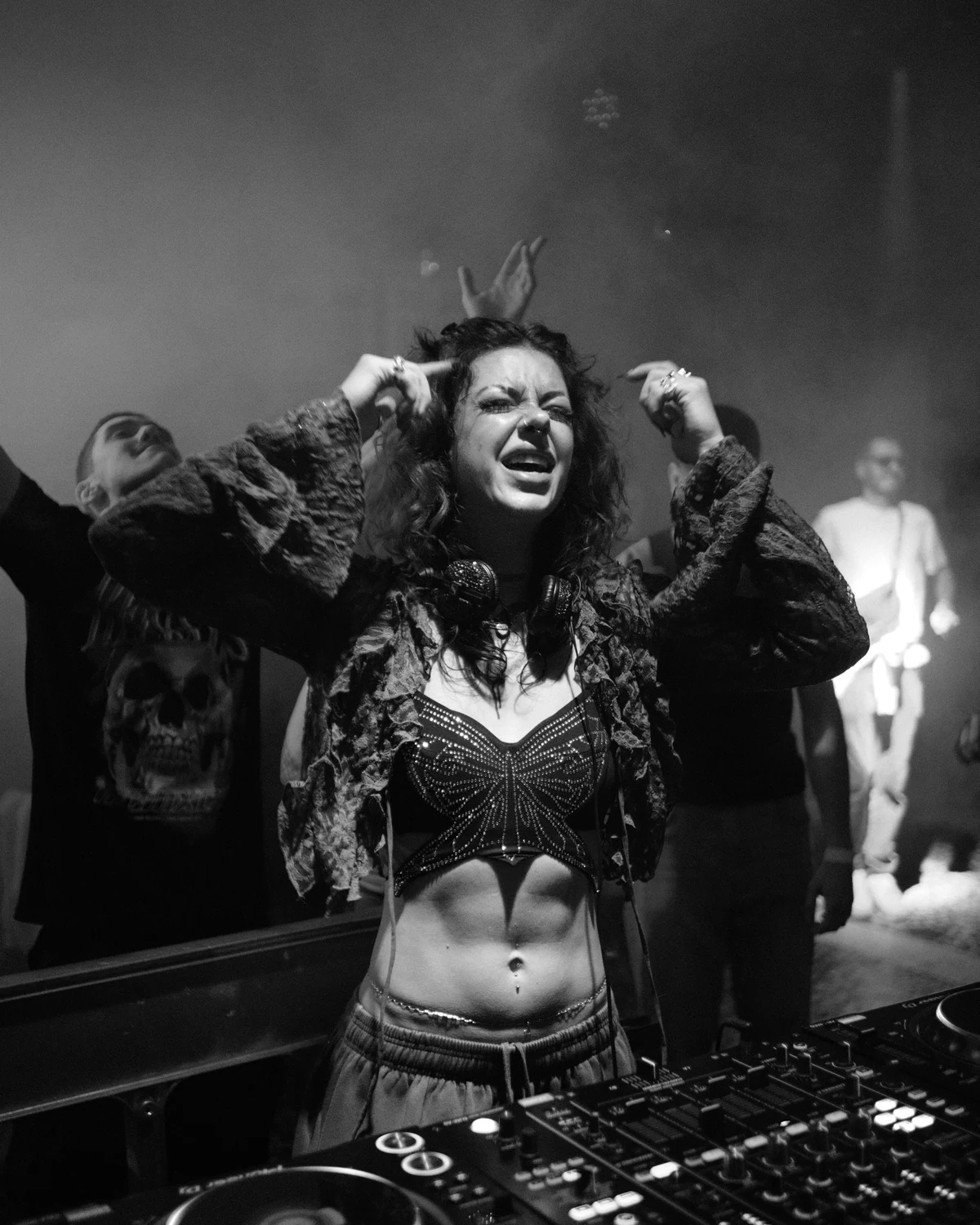
Honestly, I'm looking for that moment where I stop feeling like I'm playing to the room and start feeling like I'm inside it with everyone else.
Intensity is obviously a big part of it - I love the physicality of hard kicks and the feeling of a room moving as one, but intensity alone isn't enough in my opinion. I'm much more interested in the journey between tension and release, and in those moments where you can feel the crowd anticipating something before it happens.
I love when something emotional cuts through all that physical energy. It could be a vocal, a melody, a change in atmosphere or even just a particular transition that suddenly makes everyone react differently. Those moments are difficult to plan and that is why i love free styling with the tracks and not be focused on detail preparation before my sets. You can prepare the music, but you can't manufacture what happens between you and the room, hence why learning to read the room is a must!
So I wouldn't say the perfect dance floor is simply about losing control, it’s more about temporarily losing the separation between the artist and the audience. When everyone is completely locked into the same moment, there is this strange feeling that you're not really controlling the room anymore, you're responding to it, and it's responding to you.
That's probably the hardest thing to describe about playing. You know it when it happens. Energy never lies!
Energy never lies!
08
Evolution before expectation.
As your audience grows, more people inevitably arrive with their own idea of who Anastasiya Ty is supposed to be. How do you protect your own instincts and curiosity when expectations around an artist start becoming louder?
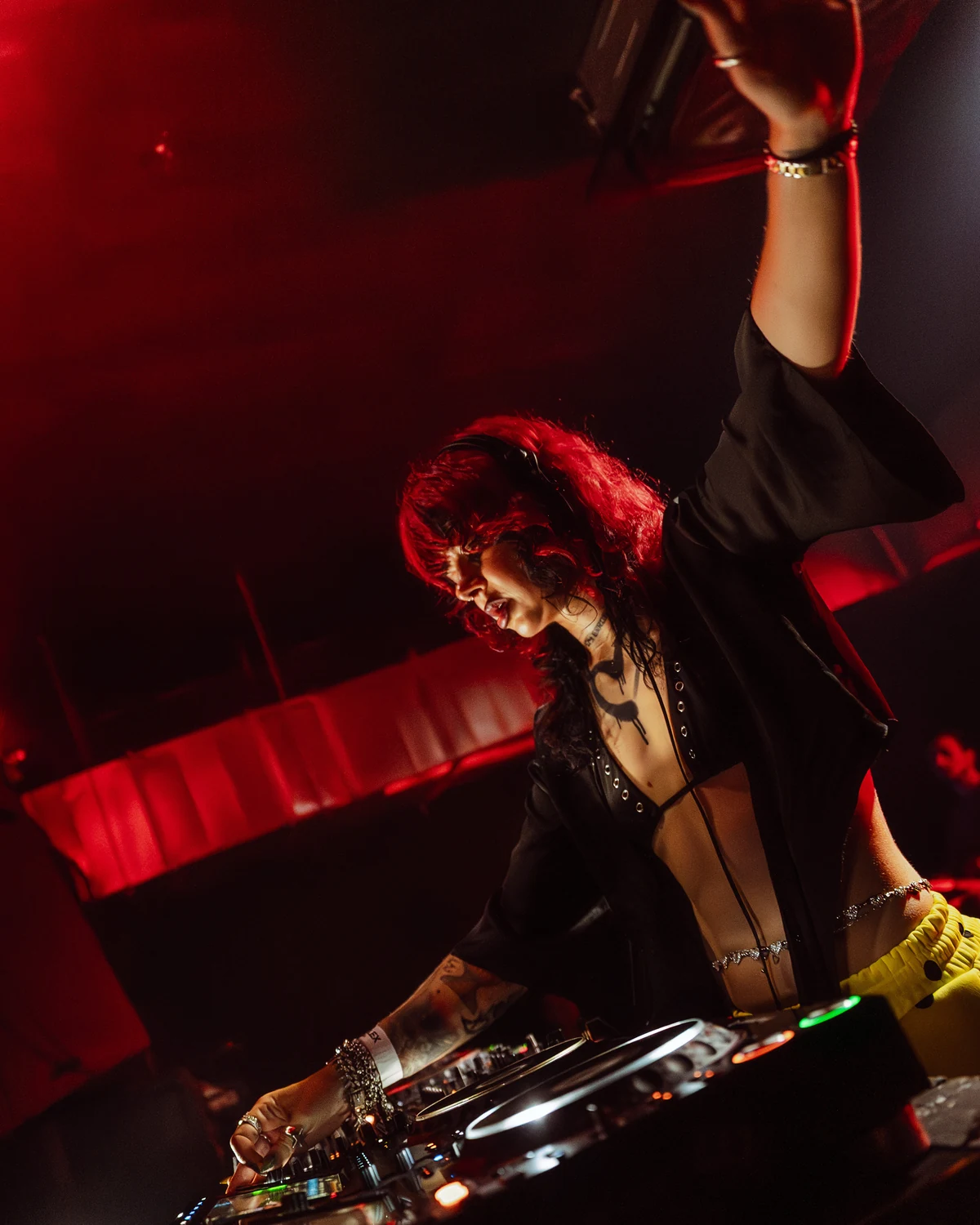
I think the only way to protect that is to remember that Anastasiya Ty belongs to me before it belongs to anyone else.
When people connect with an artist, they naturally create their own idea of who that person is and I actually think that's beautiful. If someone hears my music and creates their own image or meaning around it, I don't want to take that away from them. But I also don't want to start making decisions based on what I think people expect from me.
I've definitely felt that pressure. Specially in today’s times of social media. There can be a temptation to repeat something that worked, a certain sound, visual, energy or even a certain version of yourself, because you know people already associate you with it. But for me, repeating myself just to make other people comfortable would be much more dangerous than disappointing someone.
I'm interested in evolution. I'm allowed to change my mind, to become quieter, to become harder, to experiment with something completely different or to discover a part of myself that wasn't visible before. I don't want Anastasiya Ty to become a character I have to perform forever, i defend it to be real & raw, always.
If I stay curious, the audience gets to discover things with me. And I think that's much more exciting than giving them the same version of me every time.
Anastasiya Ty belongs to me before it belongs to anyone else.
09
The fragments miss the observer.
Artists today are often understood through fragments: a few tracks, photographs, short videos and social media posts. What is something important about you as a person or artist that those fragments almost always fail to communicate?
I think the fragments can communicate a very loud version of me, but they don't always communicate how observant I actually am.
There is a lot of intensity in Anastasiya Ty, in the music, the visuals, the performance and I think it's easy to assume that the person behind it is constantly living at that same level. In reality, I'm quite introspective. I spend a lot of time observing people, situations and myself, and thinking about why things affect me the way they do. A lot of what eventually becomes music comes from that process.
I also think people don't always see how much tenderness exists underneath the harder side of the project. I can be very intense, but I'm equally interested in connection, emotion, humour, beauty and the small things that make you feel human. Those things don't necessarily fit into a thirty-second clip or a photograph where everything has to communicate immediately.
Maybe that's also why I'm becoming more comfortable with leaving some things unexplained. I don't feel the need to show every part of myself for people to understand me. Some things are better experienced through the music.
The fragments show you pieces of Anastasiya Ty. They don't really show you the person who is quietly putting all those pieces together.
10
Becoming more yourself.
Imagine we meet again a few years from now, after the next chapter of your career has unfolded exactly as you hoped. What would you want to be able to tell us happened between this interview and that one?
I think I would want to tell you that I didn't lose myself while everything was getting further and bigger.
Of course, I would love to be able to tell you that the music reached places I couldn't have imagined, that I built the label and the projects I've been dreaming about, that I played rooms I once thought were out of reach, and that Anastasiya Ty became a world that people genuinely felt connected to, specially because they found comfort in it.
But more than the external things, I would want to say that I became even more myself. That I kept experimenting instead of becoming afraid of change. That I trusted my instincts even when they took me somewhere unexpected. That I made things because I genuinely wanted to make them, rather than because I knew they would work or were expected of me.
I'd also hope that the next few years gave me a deeper relationship with the people listening. Not just a bigger audience, but that i strengthened the real community i have behind, people who feel something when they enter this world and who can find a piece of themselves in it.
And hopefully, when we meet again, I'll be able to look back at this version of me and think: she was only just beginning to understand what she was capable of.
I think that's what I'd really want to tell you happened.
she was only just beginning to understand what she was capable of.
Signal 007
Still becoming.
Across identity, visual language, dancefloor intensity and the pressure of expectation, Anastasiya Ty keeps returning to movement rather than arrival. The project matters because it is allowed to change with the person making it.
Her final measure is not scale alone, but whether growth leaves room for curiosity, community and a deeper sense of self.
Images supplied by Anastasiya Ty.